Meta Description
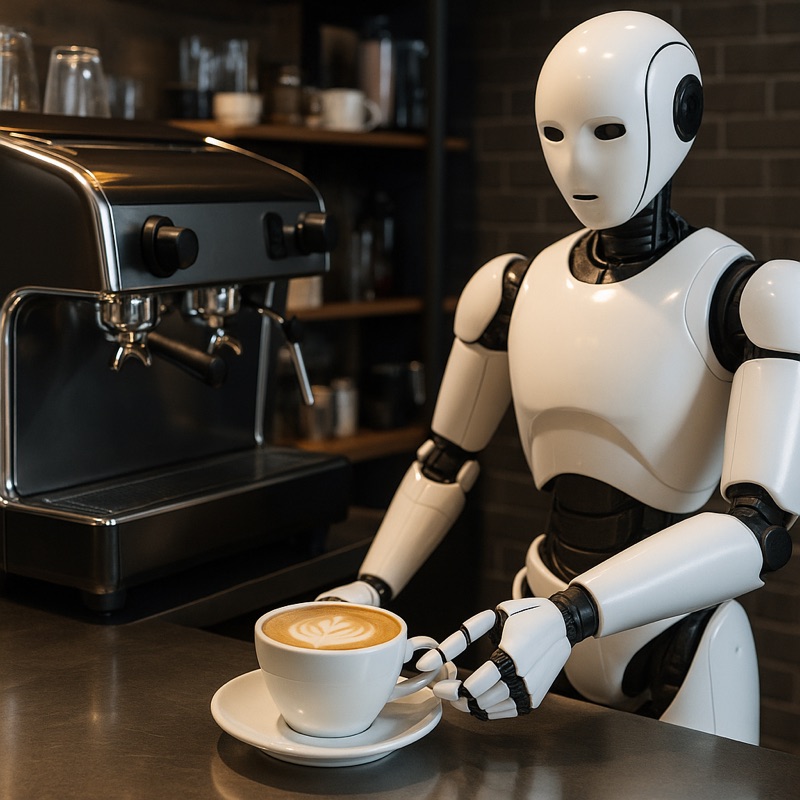
In recent years, cafés around the world have begun adopting artificial intelligence and robotics to automate coffee-making. This trend—accelerated by COVID-19 and the demand for contactless service—combines robotic arms with advanced computer-vision and machine-learning software to deliver consistent quality, faster service, and a futuristic customer experience.
Real-World Examples of Robotic Barista Cafés
Café X (San Francisco and beyond)
One of the earliest pioneers to employ robots in coffee preparation. A six-axis robotic arm makes lattes at San Francisco International Airport, described as a “robot café” designed to eliminate variables that slow down the coffee experience.
Café X later expanded to hubs such as Dubai and Tokyo, where customers can watch the robots brew each cup with precision.
Ratio (Singapore)
Operated by Ross Digital, this fully automated café uses KUKA industrial robotic arms to craft both coffee and cocktails. Orders are placed via a mobile app, and the robots handle every task—from grinding beans and heating milk to pouring syrup—within seconds.
An Internet of Things (IoT) network connects the robots to the app, enabling real-time customization and a personalized digital experience.
Artly Coffee (Seattle, USA)
This American startup runs cafés featuring robots nicknamed Jarvis and Amanda. Trained through deep learning and motion-capture, the robots learned latte-art techniques directly from a U.S. Latte Art Champion.
They grind, brew, steam milk, pour, and even draw latte art while maintaining consistent flavor. Artly’s CEO notes that robots reduce reliance on traditional labor but create new technical and creative jobs—training staff to manage and program intelligent systems.
NCM Café (San Jose, California)
In 2025, Richtech Robotics introduced Adam, a humanoid robot able to prepare over 100 kinds of coffee and cocktails while speaking four languages.
Adam recognizes returning customers through facial recognition and “learns daily,” improving after each service cycle. It’s designed to interact conversationally with guests, expanding beyond fixed tasks.
Global Initiatives
- Café X also operates at Dubai’s Museum of the Future.
- Tesla Coffee runs robotic systems in Berlin-Brandenburg Airport.
- In Thailand, Cofe+ serves 100+ recipes via an AI-powered coffee robot.
- Japan and Europe host similar pilots exploring the robot-café concept.
AI Technologies in Coffee Preparation & Customer Service
- Industrial Robotics:
Six-axis or KUKA robotic arms precisely handle pouring, mixing, and brewing.
- Computer Vision:
Cameras and sensors let robots “see” their surroundings. Jarvis in New York uses visual tracking to engage customers, while Artly applies vision algorithms to assess foam texture and color accuracy for consistent quality.
- Machine Learning & Deep Learning:
Robots are trained by recording professional baristas’ movements via motion capture, then refining them with deep-learning models. This enables human-level tamping, pouring, and taste consistency.
- Smart Ordering & IoT Integration:
Customers customize drinks via apps or touchscreens; orders sync to robots through the cloud. IoT connectivity allows real-time recipe adjustment, ingredient tracking, and operational analytics—turning every order into a digital, traceable experience.
Advantages and Challenges
Advantages
- Speed & Efficiency: Robots work nonstop at a steady rate, reportedly cutting prep time by ~30% while maintaining high quality.
- Consistency: Standardized recipes and self-calibration minimize human error.
- Long-Term Cost Savings: Although upfront investment is high, robots require no salaries or days off, improving ROI over time.
- Novel Experience: Watching a precise, talking robot brew your latte adds entertainment and marketing appeal.
- 24/7 Operation: Automation enables continuous service, even during labor shortages.
Challenges
- Lack of Human Touch: Some customers miss the warmth of a human barista.
- Maintenance & Cost: Advanced systems demand daily cleaning and technical upkeep.
- Customer Acceptance: Adoption depends on cultural comfort with automation.
- Technical & Regulatory Issues: Software or hardware faults can halt service, and compliance with food-safety standards must be continuously updated.
Impact on Employment
Automated cafés inevitably reshape the barista role. While manual tasks like grinding and pouring may decline, new jobs emerge in robot supervision, system programming, and maintenance.
As Artly’s CEO explains, “robots reduce manual labor but generate tech-driven positions.”
Future baristas might focus on recipe design and AI training rather than repetitive preparation. Studies highlight that consumer adoption hinges on perceived benefits—speed, hygiene, novelty—and comfort with automation.
Overall, routine roles will decrease while tech-skilled positions rise in the café industry’s next phase.
Future Outlook & Sci-Fi Visions
Looking ahead, barista robots will become more human-like and conversational, powered by large language models (LLMs) capable of natural dialogue. Imagine a café where a robot remembers your preferences and chats casually while brewing your drink.
Augmented Reality (AR) will enhance ordering: scanning the menu with a phone could display a 3D preview of your chosen beverage.
Future cafés may include interactive tech exhibits, holographic displays, or sensory robots that read facial expressions and adapt responses—creating a fully human-like buying experience.
Ultimately, AI and AR will redefine coffee from a beverage into an immersive technological ritual blending robotics, data, and design.


Comments
Post a Comment