 Meta Description
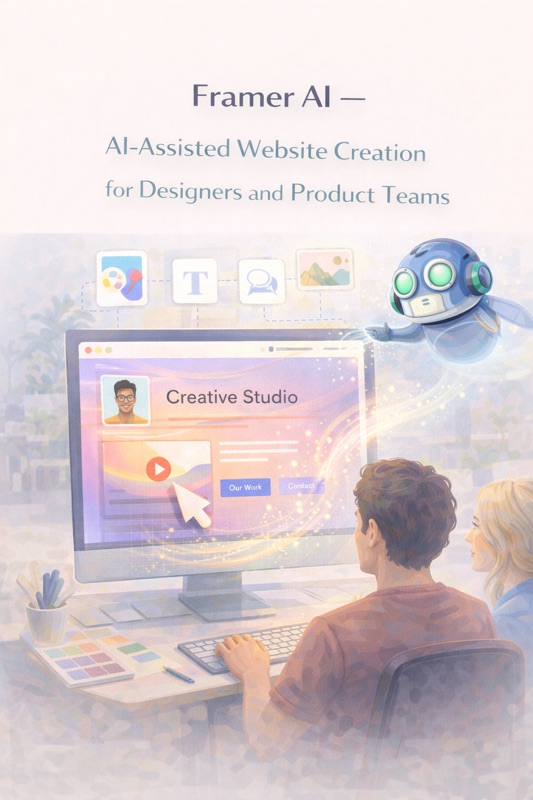
Framer AI is an AI-powered website builder that converts text prompts into fully designed, responsive websites. This article examines how Framer AI works, where it fits in modern web creation, its real strengths, and its practical limitations.
Introduction
Website creation has historically lived in two separate worlds. Designers worked in visual tools, focusing on layout, typography, and interaction. Developers translated those designs into code, managing responsiveness, performance, and deployment. While this division of labor worked, it introduced friction, delays, and repeated handoffs.
Over the last decade, tools have tried to bridge this gap. No-code platforms reduced the need for programming but often limited flexibility. Design-to-code tools accelerated handoff but still required technical effort. AI-driven website builders represent the next attempt to compress the entire process even further.
Framer AI sits at the center of this shift. Instead of asking users to assemble layouts manually, Framer AI allows them to describe a website in natural language and generates a complete, editable site in response.
This article looks at Framer AI not as a marketing claim, but as a practical tool: how it works, who it is for, what problems it solves, and where its boundaries are clearly visible.
What Is Framer AI?
Framer AI is an AI-powered extension of the Framer design and publishing platform. It enables users to generate entire website layouts—including structure, styling, and responsive behavior—by entering a text prompt.
Unlike traditional website builders that rely on templates, Framer AI dynamically constructs a site based on:
- The user’s description
- Design heuristics
- Modern web layout patterns
The output is not static. Every generated site remains fully editable inside Framer’s visual editor.
Framer Before AI: Important Context
To understand Framer AI, it helps to understand Framer itself.
Framer began as a design and prototyping tool aimed at product designers. Over time, it evolved into a platform capable of:
- Designing websites visually
- Publishing production websites
- Managing responsive layouts
- Supporting animations and interactions
Framer AI builds on this foundation. Instead of replacing Framer’s editor, AI acts as an accelerator—producing a starting point that designers can refine.
How Framer AI Works
Prompt-Driven Website Generation
The primary interaction with Framer AI is text-based. Users describe what they want, for example:
- A personal portfolio
- A SaaS landing page
- A startup homepage
- A product marketing site
Prompts can include:
- Industry or purpose
- Visual tone (clean, modern, minimal)
- Section structure (hero, features, testimonials)
- Content intent (call-to-action, value proposition)
Based on this prompt, Framer AI generates:
- Page structure
- Typography choices
- Color palette
- Layout composition
- Responsive behavior
Design System Awareness
Framer AI does not generate raw HTML files. It builds sites using Framer’s internal design and layout system, which includes:
- Responsive grids
- Component-based structure
- Constraint-based positioning
This ensures that generated sites behave correctly across screen sizes without manual breakpoint management.
Editable Output
One of Framer AI’s key design decisions is full editability. After generation, users can:
- Modify text content
- Adjust layout spacing
- Change colors and fonts
- Add or remove sections
- Insert interactions and animations
The AI does not lock users into its output. It provides a starting point, not a final product.
Practical Use Cases
Rapid Landing Page Creation
Framer AI excels at generating marketing-style pages quickly. This includes:
- Startup landing pages
- Product launches
- Personal branding sites
- Event pages
Teams can move from idea to live page in minutes rather than days.
Early-Stage Product Websites
Founders and small teams often need a credible website before they have:
- A finalized brand
- A full design team
- Development resources
Framer AI allows them to produce something polished enough to validate ideas, attract users, or collect feedback.
Designer Productivity Boost
For designers, Framer AI reduces the “blank canvas” problem. Instead of starting from nothing, they begin with a structured design that can be refined.
This shifts time away from layout scaffolding toward:
- Visual polish
- Interaction design
- Content refinement
Content-Driven Websites
Because Framer emphasizes visual layout and publishing, Framer AI works well for:
- Blogs
- Portfolio sites
- Documentation-style pages
- Marketing content
Strengths of Framer AI
Speed
The most obvious advantage is speed. Framer AI dramatically shortens the time between concept and live website.
Design-First Output
Unlike generic site builders, Framer AI produces layouts that feel intentionally designed rather than assembled from rigid templates.
Responsive by Default
Generated sites are responsive out of the box, handling different screen sizes without additional configuration.
Seamless Publishing
Framer includes built-in hosting and publishing. Once a site is ready, it can be deployed immediately without external setup.
No Code Lock-In
Although Framer abstracts code away, users are not trapped in opaque templates. The design remains flexible and modifiable.
Limitations and Constraints
Not a Full Web Application Builder
Framer AI does not generate:
- Complex backend logic
- Databases
- Authentication systems
- Dynamic business workflows
It is focused on presentation, not application logic.
Generic Starting Point Risk
AI-generated layouts can feel generic if left untouched. Without human refinement, multiple sites may end up looking similar.
Content Quality Depends on Input
The AI generates placeholder content that often requires rewriting. Clear, specific prompts improve output quality significantly.
Requires Design Judgment
While Framer AI lowers the technical barrier, it still assumes:
- Visual judgment
- Understanding of hierarchy
- Basic UX awareness
It does not replace design expertise.
Framer AI vs Traditional Website Builders
|
Aspect
|
Framer AI
|
Traditional Builders
|
|
Starting Point
|
AI-generated
|
Templates
|
|
Customization
|
High
|
Medium
|
|
Design Flexibility
|
High
|
Limited
|
|
Code Required
|
None
|
None
|
|
Best For
|
Designers, startups
|
General users
|
Framer AI prioritizes creative flexibility, whereas many builders prioritize simplicity.
Position in the AI Website Landscape
Framer AI sits alongside tools like:
- AI-assisted site generators
- Design-to-layout systems
- No-code publishing platforms
Its key distinction is its design-centric philosophy. It is not just about launching a site quickly, but about creating something that feels crafted.
Impact on Designers and Teams
Framer AI does not remove the need for designers. Instead, it changes how design time is spent:
- Less time on initial structure
- More time on refinement and storytelling
- Faster iteration cycles
For teams, this means:
- Quicker launches
- Reduced dependency on developers for static sites
- More experimentation with messaging and layout
Responsible Use and Expectations
Framer AI should be used as:
- A starting framework
- A productivity tool
- An ideation accelerator
Not as a final, unreviewed solution.
Design quality, accessibility, and clarity still depend on human decisions.
Final Insight
Framer AI represents a meaningful evolution in website creation—not by eliminating designers, but by accelerating the most time-consuming early stages of design.
Its real value lies in:
- Speed to first version
- Visual coherence
- Full editability
- Seamless publishing
Used thoughtfully, Framer AI allows creators to focus on what the website says and how it feels, rather than how fast it can be assembled.
The future of website building is not fully automated design—it is AI-assisted creativity, where structure is generated instantly and meaning is shaped by humans.


Comments
Post a Comment