Meta Description
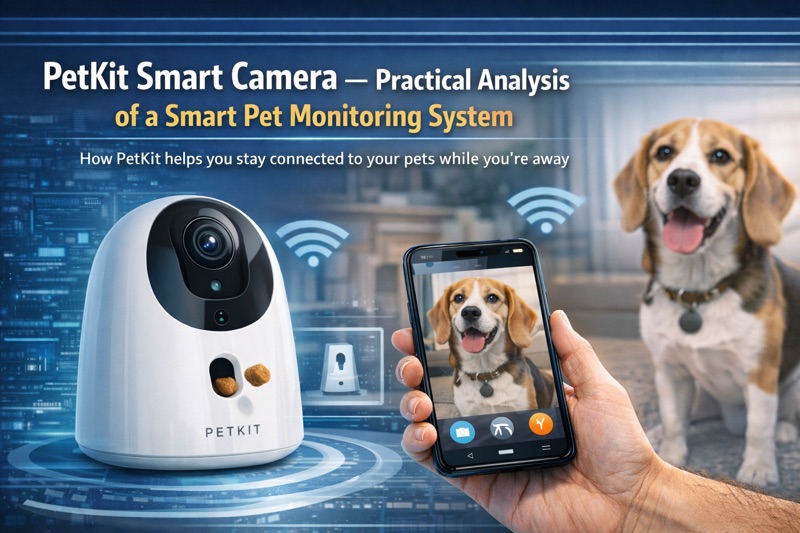
PetKit Smart Camera is a connected pet monitoring device designed to help owners track pet activity, play moments, and health signals through video, behavior alerts, and data insights. This article explores how PetKit works, where it genuinely adds value, its limitations, and how it fits into everyday pet care.
Introduction
Pet ownership has long carried a silent concern: what does my animal companion do when I’m not there? Long gone are the days of assuming the dog sleeps or the cat lounges. Owners increasingly rely on data, not guesswork, to understand behavior and wellbeing.
The surge in connected pet technology reflects this need. Smart collars track movement. GPS devices follow location. But cameras designed for pets — not just as security cameras — attempt something more: visibility plus interpretation.
PetKit Smart Camera enters this space aiming to provide owners with accessible video monitoring, activity alerts, and simple behavior insights. Positioned alongside other products like Furbo and Petcube, PetKit’s promise is to combine connectivity with practicality. But does it deliver beyond the novelty? Does it create value or simply create noise?
This review breaks down PetKit Smart Camera from the ground up — what it offers, how it performs, where it adds real benefit, where it falls short, and what pet owners can realistically expect.
What Is PetKit Smart Camera?
PetKit Smart Camera is a dedicated monitoring device tailored for pet owners. It is not a generic home camera repurposed for pet use. Instead, the system is designed with common pet behaviors in mind.
The core features typically include:
- Live video streaming (often in HD)
- Motion detection
- Sound detection alerts
- Activity tracking
- Two-way audio communication
- Cloud storage options
- Mobile app integration
- Night vision
Some PetKit models integrate with other smart devices in the ecosystem (like feeders or wearables), but the camera itself focuses on visual and acoustic monitoring.
How PetKit Smart Camera Works — Technical Structure
Understanding how PetKit functions helps set realistic expectations.
1) Hardware Core
PetKit Smart Camera includes:
- A high-resolution lens
- Built-in microphone and speakers
- Motion and sometimes sound sensors
- Infrared/night vision capability
The hardware is designed to capture both movement and audio within a defined range.
2) Connectivity and App Integration
Owners connect the camera to home Wi-Fi and an app on their smartphone. The app serves as the command center, offering:
- Live video feed
- Playback of recorded clips
- Alerts notification
- Device settings and controls
This integration moves pet monitoring from static screens to remote access.
3) Alert and Detection System
PetKit uses built-in motion and sound sensors to trigger alerts. The idea is straightforward:
- Detect movement or noise
- Notify the owner via app
- Allow review of the event
This transforms passive camera storage into active monitoring.
4) Two-Way Audio Communication
Owners can speak through the camera’s speaker and listen through the microphone. This is not voice-based behavior training, but simply remote communication.
PetKit in Everyday Use — What It Actually Does
Let’s break down PetKit’s functionality in real contexts:
1) Real-Time Video Visibility
Watching a live feed:
- Helps confirm naps, play, or rest
- Allows reassurance during absence
- Offers context beyond sound-only monitoring
This is the foundational value of the product.
2) Motion and Sound Alerts
Instead of passively waiting for issues, owners receive proactive notifications when:
- movement exceeds a threshold
- sound is detected
This cuts down silent uncertainty.
But alerts do not interpret why the activity matters. They only notify.
3) Activity Tracking Over Time
Some versions capture:
- frequent movement
- restless pacing
- repeated noise bursts
Again, this provides visibility, not explanation.
4) Two-Way Audio
Allowing owners to:
- call out to pets
- soothe them during stress
- speak during unusual moments
However, effectiveness varies significantly across animals.
Where PetKit Smart Camera Excels
PetKit shows its value in these areas:
🟢
Clarity of Environment
Seeing precisely what is happening — not guessing from sounds — removes ambiguity.
Most pet behavior questions start with:
“I wonder what he’s doing at this time…”
PetKit answers that.
🟢
Behavior Pattern Awareness
Over time, collecting clips and alerts can reveal:
- when the dog gets restless
- whether pacing follows certain events
- patterns of bark frequency
This can be valuable evidence for training or veterinary discussions.
🟢
Peace of Mind for Owners
Owners with anxiety about leaving pets alone benefit from visibility. It transforms doubt into observable patterns.
This emotional reassurance is real and measurable.
🟢
Assistive Communication
Two-way audio means owners can attempt:
- reassurances during storms or loud noises
- calm directives
- presence signals
Some pets respond positively; others do not.
Where PetKit Falls Short — The Real Limitations
Understanding limitations prevents unrealistic expectations.
🔴
Video ≠ Behavior Interpretation
Seeing a dog walk around does not tell why. PetKit gives visual data, not interpretation.
Alert when:
- dog moves
- dog barks
- sound occurs
It does not evaluate events as:
This requires human judgment.
🔴
Audio Can Mislead Instead of Calm
Two-way audio can lead to:
- excited responses
- confusion
- repeated checking for owner
Unlike human presence, remote voice is not always reassuring.
🔴
Alerts Trigger on Noise, Not Meaning
Motion plus sound triggers do not distinguish:
- play
- pacing
- exploration
- anxiety
Without filtering, alerts can overwhelm with low-value notifications.
🔴
Cloud Features and Subscriptions
Much of deep insight (history, AI alerts, extended storage) is tied to paid plans. Basic features are often free, but advanced functionality requires ongoing costs.
This must be factored into practical value.
🔴
Dependency on Internet Stability
Wi-Fi lag or weaknesses significantly reduce camera usefulness. Poor connectivity leads to:
- video dropouts
- delayed alerts
- audio interruptions
For a remote monitoring tool, stable connection is essential — not optional.
Behavioral Context — Where PetKit Fits
The most important part of any pet camera review is not features, but behavioral reality. Technology interacts with animal psychology, not just hardware.
Here’s what PetKit can and cannot help with:
What PetKit Can Do
✔️ Show what the dog does when alone
✔️ Reveal patterns over time
✔️ Notify owners of movement or sound
✔️ Provide visual evidence of specific events
✔️ Support conversations with vets/trainers with concrete data
What PetKit Cannot Do
❌ Diagnose stress or health issues
❌ Replace physical presence or training
❌ Automate behavioral correction
❌ Interpret emotional states
❌ Replace structured medical advice
Real Use Cases
Breaking PetKit use down into practical scenarios clarifies value:
Apartment and Noise-Concern Monitoring
City dwellers can track whether their dog’s bark causes disturbances, or whether pacing correlates with external triggers (traffic, sirens).
Separation Pattern Tracking
Long work hours often produce consistent mild anxiety. PetKit allows owners to assess these patterns rather than guess them.
Sitter/Visitor Verification
Owners can verify whether a pet sitter arrived, how they interacted with pets, or whether guests caused stress.
Pre-Vet Consultation Evidence
Videos and timestamps during issues (restlessness, movement, noise spikes) offer more accurate context than verbal descriptions.
Privacy and Security Considerations
Any camera device brings responsibility:
Owners should:
- secure their network
- avoid unauthorized access
- use strong passwords
- update firmware
- manage shared account permissions
This protects both pet and household privacy.
Strengths Summary
- Clear, real-time visibility
- Motion and sound alerts
- Two-way audio communication
- Activity history when recorded
- Practical reassurance for owners
Limitations Summary
- No emotional or behavioral interpretation
- Alerts that may lack context
- Subscription for advanced insights
- Reliant on stable internet
- Not a substitute for training or physical presence
Who PetKit Smart Camera Is For
PetKit suits owners who:
- want visibility, not diagnosis
- seek visual evidence over guesswork
- need remote reassurance
- want data for vet/trainer consultation
- prefer simple interaction over complex AI predictions
It is less suitable for those expecting:
- automated behavior solutions
- stress diagnosis
- health evaluation
Long-Term View
PetKit’s value grows over time if used consistently:
- daily patterns become visible
- triggers become identifiable
- routines become structured
The system is not a magic solution — it is an aid in observation and awareness.
Final Insight
PetKit Smart Camera does not “understand” pets.
It illuminates their world.
It takes silent hours and replaces them with recorded moments.
It turns guessing into observation.
For owners who care and want insight, this is meaningful.
But like all monitoring technology, PetKit does not solve deep problems — it simply makes them visible sooner.



Comments
Post a Comment