 Meta Description
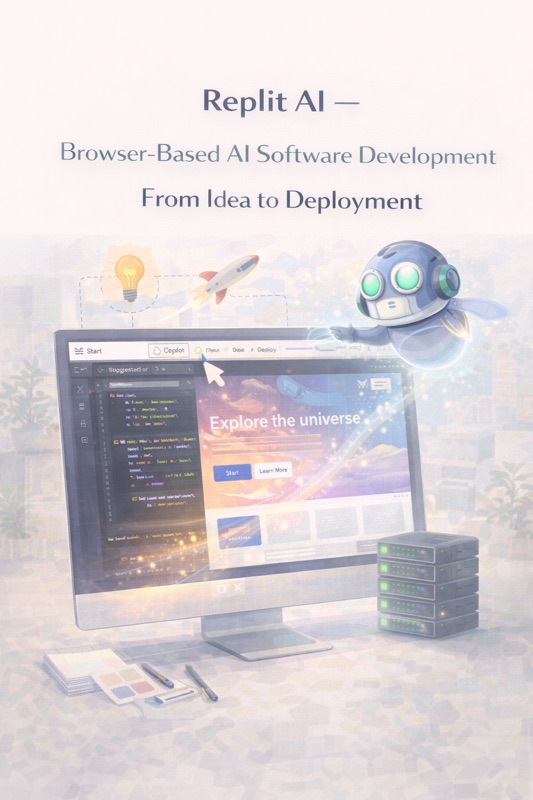
Replit AI is an AI-assisted development environment that allows users to build, debug, and deploy software entirely in the browser. This article provides an in-depth analysis of how Replit AI works, its real capabilities, limitations, and how it fits into modern software development workflows.
Introduction
Software development has never been limited by ideas. It has been limited by friction. Environment setup, dependency management, configuration errors, inconsistent machines, and onboarding delays all slow down the process of turning ideas into working software.
Cloud-based development platforms emerged to reduce this friction by removing local setup entirely. Among them, Replit became notable for allowing developers to open a browser and start coding instantly.
With the introduction of Replit AI, Replit moved beyond being a hosting environment and into the role of an active development partner. Instead of simply providing infrastructure, Replit AI assists with writing code, understanding logic, fixing errors, and deploying applications.
This article examines Replit AI as a full development system—how it works end-to-end, where it adds real value, and where its boundaries are clearly defined.
What Is Replit AI?
Replit AI is a collection of AI-powered features embedded directly into the Replit browser-based IDE. Its purpose is to assist developers throughout the entire software lifecycle, including:
- Writing new code from natural language
- Explaining existing code
- Debugging runtime and syntax errors
- Refactoring and improving code quality
- Generating boilerplate and project structure
- Deploying applications without manual infrastructure setup
Unlike editor-only AI tools, Replit AI operates inside a fully managed execution environment. Code does not just get written—it runs, fails, gets fixed, and gets deployed in the same place.
The Core Philosophy Behind Replit AI
Replit AI is built around one central idea:
Software creation should not require a local machine, complex setup, or deep infrastructure knowledge to begin.
This philosophy drives several design decisions:
- Everything runs in the browser
- AI is embedded, not bolted on
- Feedback is immediate
- Sharing and collaboration are native features
The result is a system designed to minimize friction rather than maximize raw control.
How Replit AI Works
AI-Assisted Code Generation
Replit AI allows users to generate code using natural language prompts. Developers can ask it to:
- Create functions
- Implement features
- Generate classes
- Write scripts
- Scaffold entire projects
The generated code appears directly in the editor, fully editable and immediately executable.
Unlike copy-paste tools, Replit AI integrates generation into the active project context.
Contextual Project Awareness
Replit AI does not generate code in isolation. It analyzes:
- The current file
- Project structure
- Imports and dependencies
- Variable names and patterns
- Existing logic
This allows it to produce code that fits naturally into the project rather than generic snippets.
Interactive Debugging and Error Resolution
One of Replit AI’s strongest features is its debugging support.
When code fails, users can:
- Ask why an error occurred
- Request an explanation in plain language
- Ask for a fix or alternative approach
- Step through logic interactively
This collapses the traditional debug workflow—error → search → guess → retry—into a single loop inside the IDE.
Code Explanation and Learning Support
Replit AI can explain:
- What a block of code does
- Why a certain approach works
- How different parts of the project interact
This makes it particularly useful for:
- Beginners learning to code
- Developers onboarding to new projects
- Reviewing unfamiliar codebases
- Educational environments
Supported Languages and Environments
Replit supports a wide range of programming languages, and Replit AI operates across them, including:
- Python
- JavaScript / TypeScript
- Java
- C / C++
- Go
- PHP
- Ruby
- Rust
This makes Replit AI suitable for both frontend and backend experimentation.
Deployment and Execution Model
Instant Code Execution
Code written in Replit runs instantly in the cloud environment. There is no manual compilation setup or local runtime configuration.
This immediate execution loop allows developers to:
- Test ideas quickly
- Validate AI-generated code immediately
- Iterate rapidly without setup overhead
Integrated Deployment
Replit provides built-in deployment options, allowing applications to be published directly from the IDE.
This removes the need to:
- Configure servers
- Manage hosting manually
- Set up CI/CD pipelines for small projects
While not designed for complex enterprise infrastructure, it is effective for prototypes, demos, and small services.
Practical Use Cases
Rapid Prototyping and MVPs
Replit AI excels at turning ideas into working prototypes quickly. Startups and solo builders can:
- Generate project structure
- Implement core logic
- Deploy and share a live demo
This dramatically shortens time to validation.
Education and Learning
Replit is widely used in classrooms. Replit AI enhances this by:
- Explaining errors in simple terms
- Helping students understand logic
- Reducing frustration during early learning
Used responsibly, it functions as a teaching assistant rather than a shortcut.
Collaboration and Sharing
Because Replit is cloud-based, projects can be:
- Shared via links
- Collaborated on in real time
- Forked instantly
Replit AI supports this collaborative model by accelerating routine tasks and reducing setup friction for new contributors.
Experimentation and Exploration
Developers often use Replit AI to:
- Test new languages
- Explore frameworks
- Build quick proof-of-concepts
- Validate ideas without committing to local setup
Strengths of Replit AI
Zero Setup Requirement
No local installation, configuration, or environment management is required. This is a major advantage for speed and accessibility.
End-to-End Coverage
Replit AI assists with:
- Writing
- Understanding
- Debugging
- Refactoring
- Deploying
Few tools cover this entire lifecycle within one environment.
Accessibility Across Skill Levels
Replit AI lowers entry barriers for:
- Beginners
- Non-traditional developers
- Designers experimenting with code
- Product managers prototyping ideas
Tight Feedback Loop
Because code executes instantly, AI-generated suggestions can be validated immediately, improving trust and learning.
Limitations and Constraints
Not Designed for Large-Scale Production Systems
Replit AI is not ideal for:
- Massive codebases
- Highly customized infrastructure
- Strict enterprise compliance environments
It prioritizes speed and accessibility over deep system control.
Performance Boundaries
Browser-based environments may struggle with:
- Heavy computation
- Large memory usage
- High-throughput workloads
Risk of Over-Reliance
Beginners may accept AI-generated code without understanding it. This can slow long-term learning if not managed carefully.
Internet Dependency
A stable internet connection is required for all functionality.
Replit AI vs Traditional Local Development
|
Aspect
|
Replit AI
|
Local Development
|
|
Setup
|
None
|
Manual
|
|
AI Assistance
|
Built-in
|
Tool-dependent
|
|
Execution
|
Cloud
|
Local
|
|
Collaboration
|
Native
|
External tools
|
|
Infrastructure Control
|
Limited
|
Full
|
Replit AI optimizes for speed and simplicity, not deep system customization.
Position in the AI Development Ecosystem
Replit AI belongs to a new class of AI-native development platforms that combine:
- Cloud IDEs
- Code generation
- Debugging assistance
- Deployment tooling
Unlike editor-only AI assistants, Replit AI controls the entire execution environment.
Responsible Use Guidelines
To use Replit AI effectively:
- Review all generated code
- Understand what is deployed
- Avoid blind acceptance
- Use AI as a guide, not an authority
AI accelerates development, but accountability remains human.
Final Insight
Replit AI represents a shift toward frictionless software creation. By combining AI assistance with a browser-based execution environment, it removes many traditional barriers to building and sharing software.
Its strength lies in speed, accessibility, and integration. Its limitations appear when projects require deep infrastructure control or large-scale optimization.
Used thoughtfully, Replit AI allows developers to spend less time configuring tools and more time solving problems.
The future of development is not defined by where code runs—but by how quickly ideas become working systems. Replit AI is a meaningful step toward that future.


Comments
Post a Comment