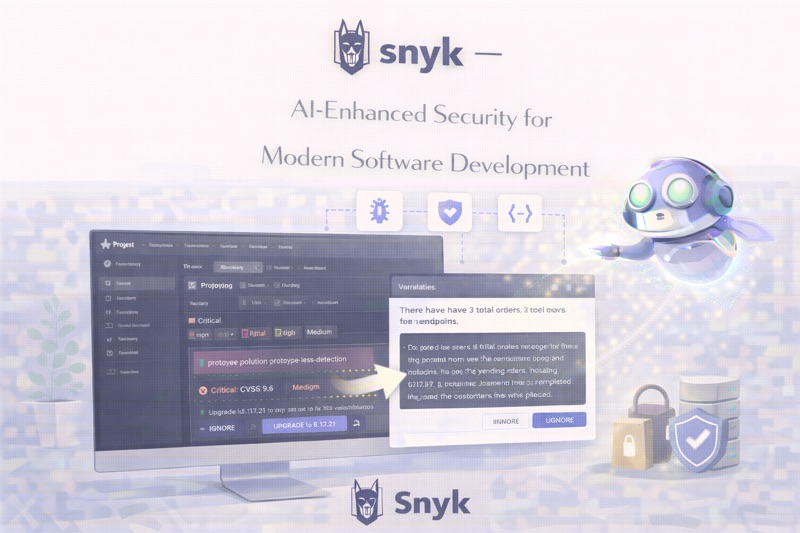
 Meta Description
Snyk is a developer-centric security platform that uses AI and automation to find and fix vulnerabilities in code, open-source libraries, containers, and cloud-native applications. This article covers how Snyk works, its real benefits, limitations, and where it fits in modern secure development workflows.
Introduction
In modern software development, speed and innovation are essential—but security cannot be an afterthought. Applications today rely on a complex web of third-party dependencies, microservices, container images, and cloud infrastructure. While this accelerates delivery, it also introduces security risk vectors at every layer: code vulnerabilities, outdated libraries, insecure configurations, and deployment misconfigurations.
Traditional security approaches used to operate as separate gates—handled by specialized teams late in the process, often slowing down development. In contrast, modern security frameworks must be integrated directly into the software development lifecycle (SDLC), empowering developers to catch and fix vulnerabilities early.
Snyk is one of the leading platforms in this space. It combines automated scanning, AI-assisted suggestions, and developer-friendly tooling to detect, prioritize, and remediate security issues in:
- Source code
- Open-source dependencies
- Container images
- Infrastructure as Code (IaC)
This article offers an in-depth look at Snyk: how it works, where it adds real value, its limitations, practical use cases, and how it fits into real engineering workflows.
What Is Snyk?
Snyk is a developer-first security platform that helps teams find and remediate vulnerabilities and misconfigurations across the software stack. It integrates with:
- Source code repositories (GitHub, GitLab, Bitbucket)
- CI/CD pipelines (Jenkins, GitHub Actions, GitLab CI)
- Container registries (Docker Hub, ECR)
- Infrastructure as Code tooling (Terraform, Kubernetes manifests)
- Artifact repositories (npm, Maven, PyPI)
Its focus is not on generating threats or alerts in isolation, but on prioritizing actionable findings developers can fix early, reducing security debt while preserving velocity.
Snyk’s automation and intelligence reduce the gap between security teams and developers—making security part of everyday development rather than a separate phase.
Core Philosophy Behind Snyk
Snyk is guided by a developer-centric philosophy:
Security should be integrated into development workflows, not bolted on later.
This philosophy manifests in several principles:
- Developer friendliness: Practical, code-first insights developers can act on.
- Automated scanning: Continuous monitoring of branches, merges, and releases.
- Actionable fixing: Not just reporting vulnerabilities, but providing fixes.
- Priority-based alerts: Focus first on the vulnerabilities that matter most.
- Ecosystem coverage: Code, dependencies, containers, and cloud configurations.
This approach makes Snyk both a security tool and a developer productivity enhancer.
How Snyk Works — Key Components
Snyk’s security capabilities are organized into several scanning and remediation vectors:
1. Snyk Code — Static Application Security Testing (SAST)
Snyk Code scans source code for security flaws such as:
- SQL injection
- Cross-site scripting (XSS)
- Logic flaws
- Insecure APIs
It operates within IDEs, pull requests, and CI pipelines, analyzing code patterns using programmatic and AI-assisted engines.
When a vulnerability is found, Snyk Code provides:
- Exact file and line references
- Severity levels
- Suggested remediation steps
The scan’s focus is clarity and actionability, not just detection.
2. Snyk Open Source — Vulnerability Scanning in Dependencies
Modern apps depend on third-party packages and libraries. Vulnerabilities often hide in these dependencies rather than in custom code.
Snyk Open Source:
- Scans dependency manifests (package.json, pom.xml, requirements.txt)
- Pulls vulnerability data from large vulnerability databases
- Identifies security flaws, outdated packages, and license risks
- Offers upgrade or patch suggestions
For example, if a library version contains a known CVE (Common Vulnerabilities and Exposures), Snyk suggests:
- The minimal version that fixes the issue
- Patch backports if available
This turns dependency risk into practical remediation steps.
3. Snyk Container — Container Image Scanning
Containers encapsulate runtime environments, but unchecked images can carry vulnerabilities.
Snyk Container:
- Scans base images and layered filesystems
- Detects outdated OS packages, insecure binaries, and misconfigurations
- Integrates with registries and build pipelines
It can automatically flag issues before deployment and offer fixes or secure alternatives.
4. Snyk Infrastructure as Code (IaC)
Infrastructure as Code files (like Terraform, CloudFormation, Kubernetes manifests) define cloud and cluster configurations. Misconfigurations here can lead to security exposures (e.g., public S3 buckets or insecure network policies).
Snyk IaC scans:
- IaC templates
- Configuration options
- Policy violations
It highlights risky setups with explanations and recommendations so that infrastructure is secure by design.
5. Snyk API & Automation
Snyk integrates via APIs and plugins with:
- IDEs (VS Code, IntelliJ)
- Version control systems
- CI/CD tools
- Build scripts
- Container registries
This ensures security checks run:
- On commits
- During builds
- On pull requests
- On deployment pipelines
The goal is to catch issues before they reach production.
Practical Developer Use Cases
Fast Feedback in Pull Requests
When a developer opens a pull request, Snyk automatically scans:
- Changed code
- Added dependencies
- New container configuration
It then comments vulnerabilities directly on the pull request, enabling fixes before merging.
Dependency Upgrade Automation
Dependencies can be updated manually, but Snyk can:
- Detect outdated insecure packages
- Recommend upgrades
- Generate pull requests for upgrade paths
This eliminates the manual overhead of dependency hygiene.
Securing Container Images
During CI builds, Snyk can scan container images and provide:
- Reports on OS package vulnerabilities
- Suggestions for safer base images
- Patch advice or upgrade guidance
This catches container risks before they reach registries or production.
Infrastructure Policy Enforcement
Snyk IaC ensures that:
- Cloud services are private unless otherwise needed
- Permissions are least-privilege
- Network configurations are restrictive and secure
This lets infrastructure engineers enforce compliance early.
Real-Time Code Insights in IDEs
Developers get vulnerability alerts and suggestions directly inside IDEs like:
- Visual Studio Code
- IntelliJ
- WebStorm
This reduces context switching and surfaces problems as code is written.
Strengths of Snyk
1. Developer-First Security
Snyk is built for developers—not just security teams. Alerts and fixes are presented in coder language, not security jargon.
This eliminates barriers between security and development.
2. Actionable Fixes, Not Just Alerts
Many tools report vulnerabilities but leave developers guessing how to fix them. Snyk suggests:
- Exact versions to upgrade
- Patch strategies
- Alternative libraries
- Remediation steps
This speeds up resolution.
3. Integration into Workflows
Snyk works where developers already work:
- Developers see issues in pull requests
- CI tools enforce security gates
- IDEs provide insights during coding
This reduces disruption and ensures security is ongoing, not downstream.
4. Broad Coverage Across the Stack
Snyk scans:
- Source code
- Dependencies
- Containers
- IaC (infrastructure)
- API surface (via API integrations)
This makes it a comprehensive risk management platform.
5. Prioritization Intelligence
Not all vulnerabilities are equally damaging. Snyk prioritizes based on:
- Severity
- Exploit likelihood
- Usage context
- Business impact
This helps teams tackle what matters first.
Limitations and Real Constraints
1. Not Fully “Automatic Security Fixing”
Snyk suggests fixes, but developers still must:
- Review changes
- Evaluate compatibility
- Merge pull requests
- Test builds
This preserves responsibility but means human effort remains part of the workflow.
2. Dependency on Vulnerability Data
Snyk relies on known CVE databases and proprietary feeds. Zero-day or undisclosed vulnerabilities won’t be detected until they’re catalogued.
3. Possible Noise If Misconfigured
Without careful configuration, Snyk may generate alerts that feel overwhelming—especially on large legacy codebases with many dependencies.
Teams must:
- Customize policies
- Tune severity thresholds
- Focus on meaningful risks
4. Cost and Scaling Considerations
Snyk offers free tiers, but enterprise usage, organization-wide security automation, and large pipelines may require paid plans. This should be considered in budgeting.
Snyk in the Security Tool Landscape
Snyk sits between traditional security scanning tools and modern developer-first platforms. It does things other tools do not:
|
Capability
|
Snyk
|
Traditional SAST
|
Generic Scanners
|
|
Developer Integrated
|
✔️
|
❌
|
❌
|
|
Dependency Scanning
|
✔️
|
⚠️
|
✔️
|
|
Container Scanning
|
✔️
|
⚠️
|
✔️
|
|
IaC Policy Scanning
|
✔️
|
❌
|
❌
|
|
Actionable Fixes
|
✔️
|
⚠️
|
⚠️
|
|
Pull Request Integration
|
✔️
|
⚠️
|
❌
|
Snyk’s strength is practical, integrated security rather than isolated scanning.
Responsible Use and Best Practices
To use Snyk effectively:
- Enable scanning early: Integrate with pull requests and CI.
- Tune severity policies: Focus on critical issues first.
- Automate upgrade PRs: Let Snyk offer fixes so developers can review.
- Audit frequently: Schedule regular scans of containers and IaC.
- Educate teams: Share remediation practices and platform insights.
Security should be preventive, not reactive.
Final Insight
Security is no longer a separate discipline performed only at the end of development. It must be integrated into everyday workflows so that risks are caught early, fixed quickly, and understood by developers.
Snyk is not a magic solution—no tool can single-handedly make software secure. But it serves as a practical, developer-friendly security assistant, turning vulnerability management from an overwhelming chore into manageable, actionable tasks.
By bringing security into the spaces where developers already work (IDEs, pull requests, CI), Snyk helps teams reduce risk without sacrificing delivery speed.
The future of secure development is not security separate from development—it is security built into development workflows. Snyk exemplifies this future.


Comments
Post a Comment